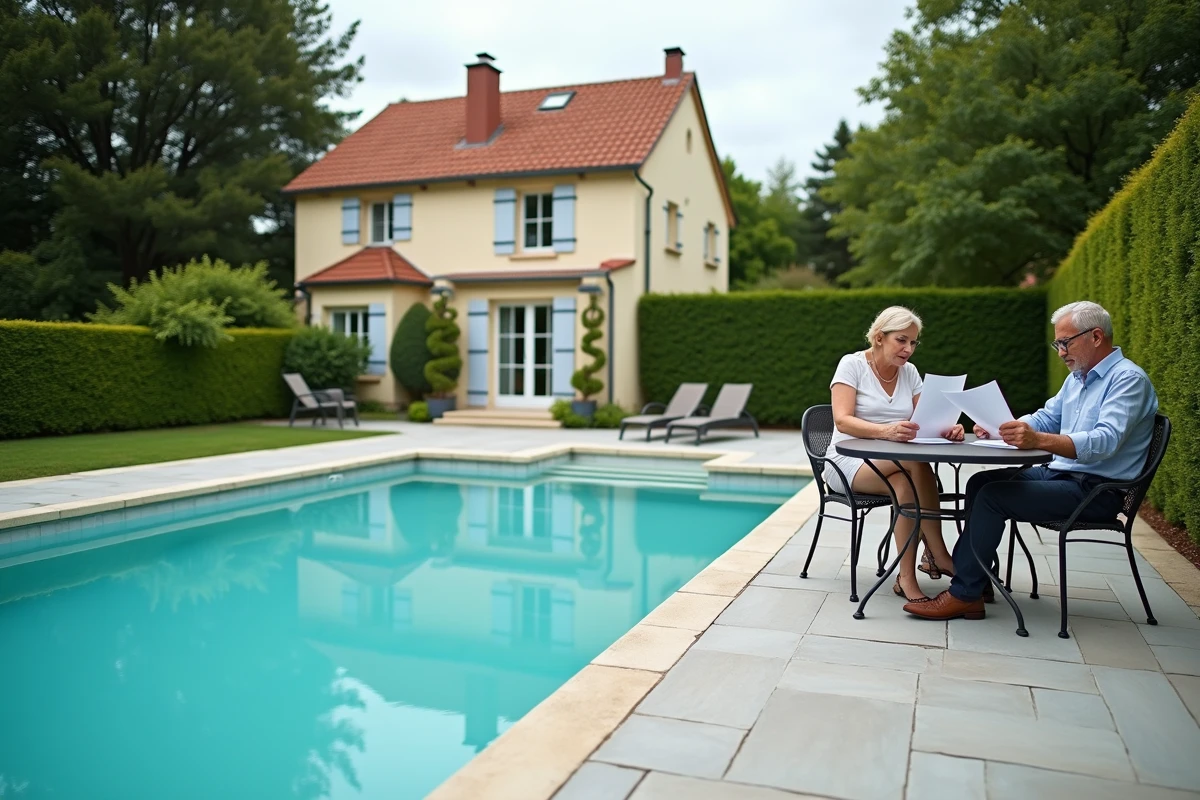
Installing an in-ground pool in your garden changes the property tax base of the real estate. The mechanism relies on the cadastral rental value, recalculated as soon as a permanent built element is added to the property. This recalculation directly affects the property tax and sometimes other local levies.
Cadastral rental value and pool: the calculation mechanism
The property tax is based on the cadastral rental value of the property, which is the theoretical annual rent that the property could generate. Any fixed construction added to the land, including an in-ground pool, is considered a built amenity forming an outbuilding. The tax administration then includes this outbuilding in the overall calculation.
Specifically, the surface area of the pool, its nature (masonry, fiberglass, shotcrete) and the associated equipment (technical room, pool house) are included in the evaluation. Field reports vary on this point: depending on the municipality and the competent property tax service, the revaluation can vary significantly.
To understand in detail the integration of the property tax and in-ground pool, several local parameters come into play, notably the rate voted by the municipality and the intercommunal authority.
Mandatory declaration within 90 days: form and penalties
After the completion of the work, the owner has 90 days to declare the construction to the property tax center. The form used is Cerfa 6704-IL (or form H1 depending on the situation). This deadline starts from the date of completion of the work, not from the date of the permit or the prior declaration of work.
Since 2024, the “Innovative Property” program deployed by the General Directorate of Public Finances uses aerial imagery combined with artificial intelligence to identify undeclared pools. Tax adjustments for undeclared pools accelerated in 2025-2026. The risk is no longer theoretical: owners who fail to declare expose themselves to a tax reassessment along with penalties.
Elements to declare
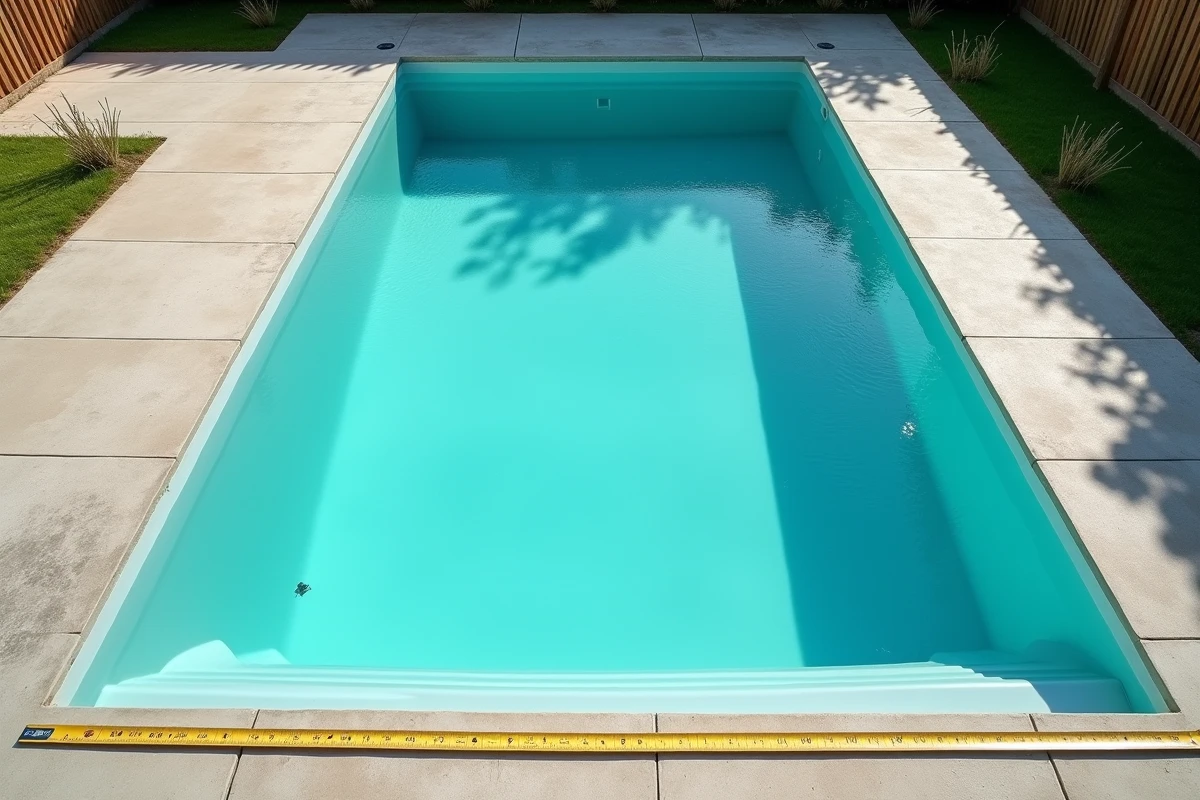
- The surface area of the pool in square meters, measured from inner edge to inner edge, which determines the calculation base for the development tax and the property revaluation.
- Ancillary constructions related to the pool (technical room, fixed pool cover, adjoining masonry terrace) which are also considered taxable built elements.
- The date of completion of the work, which determines the starting point of the 90-day deadline and the year of the first taxation.
Temporary exemption from property tax: two years under conditions
An in-ground pool can benefit from a property tax exemption for the two years following its completion, provided that the declaration has been submitted within the 90-day deadline. This exemption operates on the same principle as that granted to new constructions.
However, this exemption is not automatic in all municipalities. A local authority can, by deliberation, eliminate or reduce this exemption for the portion that it is entitled to. In practice, some owners discover at the time of the tax notice that their municipality has voted against this measure. Inquiring with the property tax service before starting work allows for this parameter to be integrated into the overall project budget.
Development tax for pools over 10 m²: a unique cost to anticipate
Alongside the property tax, the construction of a pool larger than 10 m² triggers the payment of a development tax. Unlike the property tax, which is annual, the development tax is a one-time levy, due after obtaining the urban planning permit.
Its calculation is based on a fixed value per square meter, set each year. In 2026, this value rose to 251 euros per square meter, down from 262 euros in 2025, due to the decrease in the construction cost index. The final amount then depends on the municipal rate and the departmental rate applied.
Simplified calculation example
For a pool of 30 m², the 2026 fixed base is established at 30 multiplied by 251 euros. On this basis, the municipal rate (variable depending on the territories) and the departmental rate are applied. The total amount can be paid in one or two installments depending on the threshold set by the administration.

Second homes with pools: surcharges in tight areas
Owners of second homes equipped with a pool face a double tax effect. The pool increases the cadastral rental value, and in tight areas, municipalities can vote for a surcharge on the housing tax for second homes ranging from 5 to 60%. These two mechanisms accumulate.
In certain tourist or coastal municipalities, the combination of the increase in rental value related to the pool and the voted surcharge results in local tax increases that far exceed initial estimates. The available data does not allow for a universal range, as situations vary from one municipality to another.
- Check if the municipality applies the surcharge for second homes and at what rate before starting the project.
- Distinguish between property tax (due by the owner) and housing tax for second homes (due by the occupant as of January 1), as both are impacted by the pool.
- Consider the cumulative annual tax cost in the long-term budget of the project, beyond just the construction cost.
The tax impact of an in-ground pool is not limited to an additional line on the property tax notice. Between the development tax paid at construction, the permanent cadastral revaluation, and any local surcharges, the real cost depends almost as much on the municipality’s tax policy as on the size of the pool. Consulting the property tax service at the location of the property remains the most reliable approach before pouring the first slab.